Technical Documents
Specifications
Brand
onsemiProduct Type
Monostable Multivibrator
Logic Family
TTL
Number of Elements per Chip
2
Minimum Pulse Width
120ns
Maximum Quiescent Current
150μA
Minimum Supply Voltage
3V
Mount Type
Surface
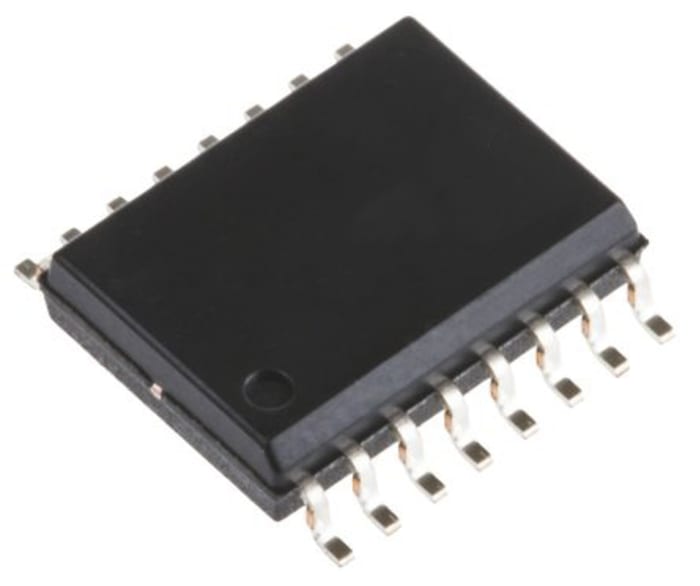
Package Type
SOIC
Maximum Supply Voltage
18V
Pin Count
16
Maximum Propagation Delay Time @ CL
15μs
Minimum Operating Temperature
-55°C
Multivibrator Type
Frequency Divider
Maximum Operating Temperature
125°C
Length
10mm
Height
1.5mm
Standards/Approvals
No
Series
MC14521
Automotive Standard
AEC-Q100
Product Details
The MC14521B consists of a chain of 24 flip-flops with an input circuit that allows three modes of operation. The input will function as a crystal oscillator, an RC oscillator, or as an input buffer for an external oscillator. Each flip-flop divides the frequency of the previous flip-flop by two, consequently this part will count up to 224 = 16,777,216. The count advances on the negative going edge of the clock. The outputs of the last seven-stages are available for added flexibility.

Ideate. Create. Collaborate
JOIN FOR FREE
No hidden fees!


Stock information temporarily unavailable.
P.O.A.
Each (In a Pack of 25) (ex VAT)
Standard
25
P.O.A.
Each (In a Pack of 25) (ex VAT)
Stock information temporarily unavailable.
Standard
25
Ideate. Create. Collaborate
JOIN FOR FREE
No hidden fees!
Technical Documents
Specifications
Brand
onsemiProduct Type
Monostable Multivibrator
Logic Family
TTL
Number of Elements per Chip
2
Minimum Pulse Width
120ns
Maximum Quiescent Current
150μA
Minimum Supply Voltage
3V
Mount Type
Surface
Package Type
SOIC
Maximum Supply Voltage
18V
Pin Count
16
Maximum Propagation Delay Time @ CL
15μs
Minimum Operating Temperature
-55°C
Multivibrator Type
Frequency Divider
Maximum Operating Temperature
125°C
Length
10mm
Height
1.5mm
Standards/Approvals
No
Series
MC14521
Automotive Standard
AEC-Q100
Product Details
The MC14521B consists of a chain of 24 flip-flops with an input circuit that allows three modes of operation. The input will function as a crystal oscillator, an RC oscillator, or as an input buffer for an external oscillator. Each flip-flop divides the frequency of the previous flip-flop by two, consequently this part will count up to 224 = 16,777,216. The count advances on the negative going edge of the clock. The outputs of the last seven-stages are available for added flexibility.
Ideate. Create. Collaborate
JOIN FOR FREE
No hidden fees!