技術文件
規格
Brand
BroadcomMount Type
Surface
Product Type
Optocoupler
Number of Channels
1
Number of Pins
8
Typical Rise Time
2.7μs
Maximum Input Current
230mA
Minimum Operating Temperature
-40°C
Maximum Operating Temperature
110°C
Standards/Approvals
RoHS
Typical Fall Time
2.7μs
Series
ACNT-H870
Automotive Standard
No
原產地
Philippines
產品詳情
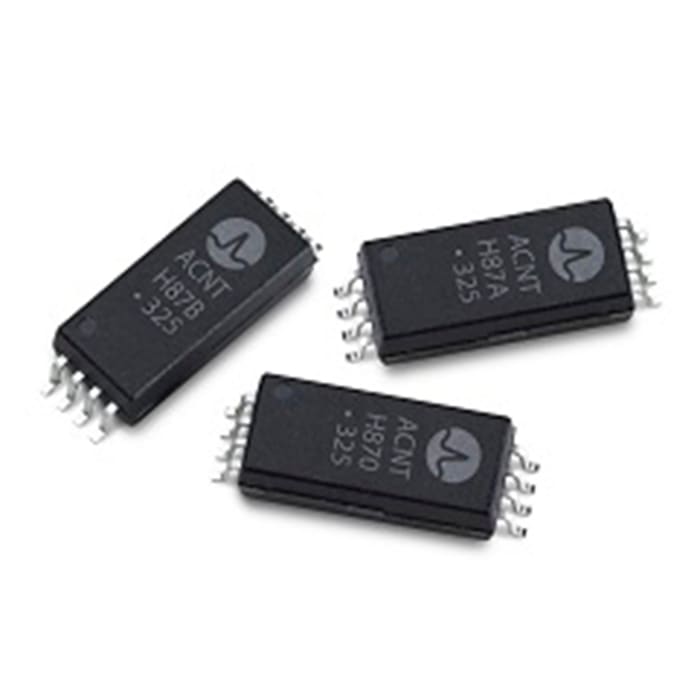
The Broadcom ACNT-H870 voltage sensors are optical isolation amplifiers designed specifically for voltage sensing. Its 2V input range and high 1-GW input impedance makes it well suited for isolated voltage sensing requirements in electronic power converters applications including motor drives and renewable energy systems. In a typical voltage sensing implementation, a resistive voltage divider is used to scale the DC-link voltage to suit the input range of the voltage sensor. A differential output voltage that is proportional to the input voltage is created on the other side of the optical isolation barrier.
暫時無法取得庫存資訊。
55,065.30 MOP
55.065 MOP Each (On a Reel of 1000) (不含稅)
1000
55,065.30 MOP
55.065 MOP Each (On a Reel of 1000) (不含稅)
暫時無法取得庫存資訊。
1000
| 數量 | 單價 | 每卷 |
|---|---|---|
| 1000 - 1000 | 55.065 MOP | 55,065.28 MOP |
| 2000+ | 53.964 MOP | 53,963.88 MOP |
技術文件
規格
Brand
BroadcomMount Type
Surface
Product Type
Optocoupler
Number of Channels
1
Number of Pins
8
Typical Rise Time
2.7μs
Maximum Input Current
230mA
Minimum Operating Temperature
-40°C
Maximum Operating Temperature
110°C
Standards/Approvals
RoHS
Typical Fall Time
2.7μs
Series
ACNT-H870
Automotive Standard
No
原產地
Philippines
產品詳情
The Broadcom ACNT-H870 voltage sensors are optical isolation amplifiers designed specifically for voltage sensing. Its 2V input range and high 1-GW input impedance makes it well suited for isolated voltage sensing requirements in electronic power converters applications including motor drives and renewable energy systems. In a typical voltage sensing implementation, a resistive voltage divider is used to scale the DC-link voltage to suit the input range of the voltage sensor. A differential output voltage that is proportional to the input voltage is created on the other side of the optical isolation barrier.