技術文件
規格
Brand
RS ProMaterial Type
Polylactic Acid
Product Type
3D Printer Filament
Printing Technology
Fused Deposition Modelling (FDM)
Colour
Grey
For Use With
Common Desktop 3D Printers
Weight
500g
Diameter
2.85mm
Printing Material
PLA Glitter
Printing Maximum Temperature
215°C
Standards/Approvals
No
原產地
Netherlands
產品詳情
Poly Lactic Acid (PLA) is a plastic made from renewable natural resources and one of the most popular materials for 3D printing. Plastics such as PLA are the most popular 3D printing material due to its simplicity, dimensional accuracy and low cost.
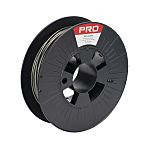
RS PRO METALLIC PLA is a highly aesthetical PLA based filament with sparkling flakes inside. Slightly modified, the filament retains the typical features of PLA, but is tougher and less brittle. The sparkling flakes helps concealing layer lines. Because of the translucency of PLA combined with the flakes, the colour saturation can be increased by increasing wall thickness. No need for special nozzle as the material is not abrasive. It is recommended to purge the nozzle after printing, to prevent build-up of flakes for the next print
暫時無法取得庫存資訊。
P.O.A.
1
P.O.A.
暫時無法取得庫存資訊。
1
技術文件
規格
Brand
RS ProMaterial Type
Polylactic Acid
Product Type
3D Printer Filament
Printing Technology
Fused Deposition Modelling (FDM)
Colour
Grey
For Use With
Common Desktop 3D Printers
Weight
500g
Diameter
2.85mm
Printing Material
PLA Glitter
Printing Maximum Temperature
215°C
Standards/Approvals
No
原產地
Netherlands
產品詳情
Poly Lactic Acid (PLA) is a plastic made from renewable natural resources and one of the most popular materials for 3D printing. Plastics such as PLA are the most popular 3D printing material due to its simplicity, dimensional accuracy and low cost.
RS PRO METALLIC PLA is a highly aesthetical PLA based filament with sparkling flakes inside. Slightly modified, the filament retains the typical features of PLA, but is tougher and less brittle. The sparkling flakes helps concealing layer lines. Because of the translucency of PLA combined with the flakes, the colour saturation can be increased by increasing wall thickness. No need for special nozzle as the material is not abrasive. It is recommended to purge the nozzle after printing, to prevent build-up of flakes for the next print